
Skip to content
Tīrthas

Gauḍīya places

Vraja, Navadvīpa and Purī, and the places connected with Śrī Caitanya Mahāprabhu and the Gosvāmīs.

Source boundary visible4 active units

Gauḍīya place study

Connect Vraja, Navadvīpa and Purī claims to identifiable Gauḍīya sources.

The school developed these teaching notes. They are not presented as Aniruddha Dāsa's authored commentary. The source trail and limits remain visible for human review.

Learners moving from source reading to practice and teaching
Learn visibly: retrieve · make · discuss · teach · return
Learning outcomes
  • Create something that can be inspected
  • Keep source, interpretation and uncertainty visible
  • Use teach-back as evidence of understanding
Saved on this device0%
Course sequence

Make evidence at every step

Teach-back

Explain the result to another person without looking, then reopen the source and correct the explanation visibly.

Completion evidence

A provenance-labelled place profile.

Research and source trail
Read the complete teaching notesOpen
Full lesson readerFormative assessment included

Read less. Do more. Show what changed.

Every unit below contains an explanation, a worked model, immediate practice, a source boundary and a check for understanding. The familiar “learning pyramid” percentages are not used; its useful active modes are rebuilt here with retrieval, spacing, feedback and learner choice.

Encounter
Retrieve
Demonstrate
Discuss
Practise
Teach
Choose a lesson

All 4 lessons are complete.

Lesson 1 of 4

Locate

Record rounded coordinates and the kind of geographic reference point.

1 · Understand the move

A map point or photograph can orient a visitor; it cannot by itself prove a historical, textual or tradition-specific claim.

In this lesson, the concrete target is A checked map point. Begin by defining what a successful example would contain and what it would deliberately leave out. This makes the standard inspectable before anyone is assessed.

2 · Worked model

Build the place record in layers: geographic reference point, identified source, named tradition, current local guidance and your field observation.

I noticeI decideI verify
3 · Practise now

Put the source away and make a first attempt in ten minutes. Do not polish it. Reopen the source, underline corrections and write one sentence explaining why each correction mattered. Then use the result in a new situation.

Apply the same source card to a second place, then compare what is textually attested, locally remembered and personally observed.

4 · Check the boundary

Keep variant accounts visible. Record edition, translator, access date and who supplied local guidance instead of silently merging them.

  • The result is visible: a checked map point.
  • A reader can distinguish source, interpretation, illustration and uncertainty.
  • The learner can explain the central move without looking, then correct it from the source.

Autosaved privately on this device.
Performance assessment

Evidence before completion

Four-part rubric
Accuracy
Claims match the cited source and limits are named.
Understanding
The learner explains relationships, not only wording.
Application
The central move works in a new case or audience.
Teaching
Another person can follow, question and verify it.
Inspect sources and classroom resourcesOpen
Starter library3 complete model resources

Open, use and adapt - not an empty shelf

These complete, source-linked resources accompany Gauḍīya place study. Each one includes a bounded reading, a visual sequence, an immediate practice and a direct source trail. They may be reviewed, rewritten or replaced without misattributing authorship.

Study tools, folios and learning symbols
Read · see · attempt · verify · teach
Field guideResearch edition

Five layers of a trustworthy place profile

Geography, textual evidence, tradition, current guidance and observation remain distinct.

Complete reading

Begin with a rounded coordinate and say what it represents: town centre, temple gate or another reference point. Add each textual claim with work, edition and passage. Name the tradition behind a significance claim rather than presenting it as a neutral map fact.

Current opening times, access, dress, transport and safety must be confirmed locally. After visiting, write observations as observations. A personal experience may be meaningful without becoming evidence for a historical claim.

Visual sequence
  1. 1Locate
  2. 2Source and name tradition
  3. 3Confirm locally
Do it now

Take one place card and colour-code geographic, textual, traditional, practical and personal statements.

Source: IIT Kanpur · identified textual and commentarial witnesses
Route worksheetResearch edition

Plan a yātrā around learning and physical reality

A route is not complete until purpose, rest, access and local verification are included.

Complete reading

Write one learning question for each stop and place the most demanding visit when the group has energy. Straight-line distances are useful for orientation, not transport planning. Record the route provider and the date travel conditions were checked.

Build alternatives for heat, crowds, mobility, closures and fatigue. A shorter attentive visit may serve the learning purpose better than collecting more locations. Make quiet reflection and post-visit correction part of the itinerary.

Visual sequence
  1. 1Set one question per stop
  2. 2Check access and rest
  3. 3Reflect and correct
Do it now

Remove one stop from a crowded route and use the recovered time for observation, discussion and a source check.

Source: CAST · access, agency and multiple ways to participate
Comparison labResearch edition

Keep variant sacred-place accounts visible

Comparison becomes honest when traditions and editions are not silently merged.

Complete reading

Make one column per identified source rather than one synthetic story. Compare date, location, actors, event and purpose. An empty cell means the source is silent; it does not automatically mean agreement or contradiction.

After the table, state what is shared, what differs and what requires expert review. Use tradition-specific vocabulary first, then add a clearly labelled comparative synthesis for learners who need orientation.

Visual sequence
  1. 1Transcribe separately
  2. 2Compare exact dimensions
  3. 3Label synthesis
Do it now

Build a two-source table and write one sentence you are no longer willing to state without qualification.

Source: NCF 2023 · inquiry, comparison and experiential learning
Open practice and export toolsOpen
Complete local moduleAutosaves on this device

Learn by making something

Use the tool, inspect its limits, save evidence of your work, explain it to somebody else, then return and improve it. Model records are included so the workflow never begins as an empty form.

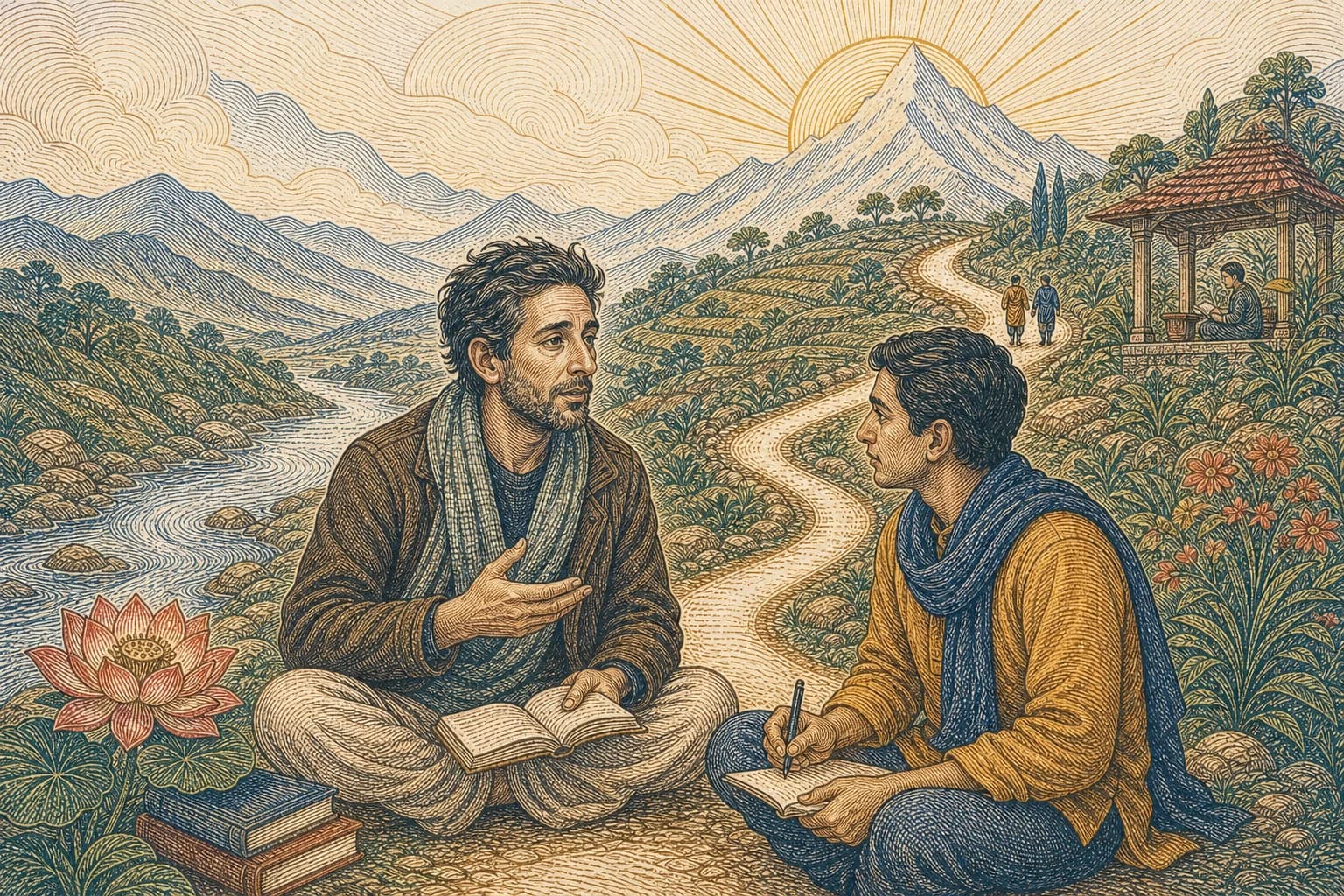
A study scene with learners, folios and a winding path
Encounter · recall · practise · discuss · teach · return
Checked place index

Choose stops

Route notebook

2 stops · 24 km straight-line

  1. 1

    Vṛndāvana वृन्दावन

    27.581, 77.697

  2. 2

    Govardhana गोवर्धन

    27.500, 77.467

Distances are geographic estimates, not road routes. Place significance is deliberately not inferred from coordinates.

The learning rhythm

Every lesson moves from receiving to sharing

See the method
  1. 01Encounter
  2. 02Recall
  3. 03Apply
  4. 04Discuss
  5. 05Teach
  6. 06Return