
Skip to content
About

Write to us

Questions, corrections and disagreements are all welcome. If something here is wrong, we would rather know than not.

Source boundary visible4 active units

Correction and inquiry desk

A useful correction identifies the page, exact claim, proposed change and evidence.

The school developed these teaching notes. They are not presented as Aniruddha Dāsa's authored commentary. The source trail and limits remain visible for human review.

Learners moving from source reading to practice and teaching
Learn visibly: retrieve · make · discuss · teach · return
Learning outcomes
  • Create something that can be inspected
  • Keep source, interpretation and uncertainty visible
  • Use teach-back as evidence of understanding
Saved on this device0%
Course sequence

Make evidence at every step

Teach-back

Explain the result to another person without looking, then reopen the source and correct the explanation visibly.

Completion evidence

An exportable correction record ready to send when a contact channel is connected.

Research and source trail
Read the complete teaching notesOpen
Full lesson readerFormative assessment included

Read less. Do more. Show what changed.

Every unit below contains an explanation, a worked model, immediate practice, a source boundary and a check for understanding. The familiar “learning pyramid” percentages are not used; its useful active modes are rebuilt here with retrieval, spacing, feedback and learner choice.

Encounter
Retrieve
Demonstrate
Discuss
Practise
Teach
Choose a lesson

All 4 lessons are complete.

Lesson 1 of 4

Claim

Write the smallest useful claim and intended reader.

1 · Understand the move

A publishable record begins with a bounded claim and intended reader. Provenance and rights belong beside the source before prose is polished.

In this lesson, the concrete target is A one-sentence brief. Begin by defining what a successful example would contain and what it would deliberately leave out. This makes the standard inspectable before anyone is assessed.

2 · Worked model

Draft in reviewable blocks: claim, evidence, explanation, visual, learner action and source note. Label research-edition synthesis explicitly.

I noticeI decideI verify
3 · Practise now

Put the source away and make a first attempt in ten minutes. Do not polish it. Reopen the source, underline corrections and write one sentence explaining why each correction mattered. Then use the result in a new situation.

Turn the same source into a short article, a three-minute script and a teach-back prompt. Preserve the claim and provenance across formats.

4 · Check the boundary

A fluent paragraph is not evidence. Check quotation, attribution, edition, licence, accessibility and unresolved uncertainty independently.

  • The result is visible: a one-sentence brief.
  • A reader can distinguish source, interpretation, illustration and uncertainty.
  • The learner can explain the central move without looking, then correct it from the source.

Autosaved privately on this device.
Performance assessment

Evidence before completion

Four-part rubric
Accuracy
Claims match the cited source and limits are named.
Understanding
The learner explains relationships, not only wording.
Application
The central move works in a new case or audience.
Teaching
Another person can follow, question and verify it.
Inspect sources and classroom resourcesOpen
Starter library3 complete model resources

Open, use and adapt - not an empty shelf

These complete, source-linked resources accompany Correction and inquiry desk. Each one includes a bounded reading, a visual sequence, an immediate practice and a direct source trail. They may be reviewed, rewritten or replaced without misattributing authorship.

Study tools, folios and learning symbols
Read · see · attempt · verify · teach
Model content recordResearch edition

A verse source record that can survive export

Identity, source, rights, transformations and review state travel with the text.

Complete reading

Store work, chapter, verse, script, transliteration scheme, repository revision and import date. Record which fields were imported and which were written for this site. A generated explanation must remain labelled research edition until human review changes its state.

Rights metadata belongs to each asset or source, not a general folder note. Review state should show who checked what and when, with rejection or uncertainty preserved instead of overwritten.

Visual sequence
  1. 1Identify
  2. 2Record rights and transformations
  3. 3Review with an audit trail
Do it now

Export a draft from the studio and confirm that another editor could identify every source without opening your browser.

Source: gita/gita · source dataset
Model review gateResearch edition

Accuracy, attribution, rights, access, learning

Five independent gates keep polish from disguising an incomplete record.

Complete reading

Accuracy checks the claim. Attribution checks who supplied each layer. Rights checks permitted use and required notice. Access checks alternative text, captions, keyboard flow and language. Learning checks that the page produces an observable action and feedback.

A record passes only when each applicable gate has evidence. “Reviewed” without a dimension and reviewer is not useful. Failed gates create an explicit next action and keep the item out of public state.

Visual sequence
  1. 1Check independently
  2. 2Attach evidence
  3. 3Route failures
Do it now

Review one starter article against all five gates and write the exact evidence for each pass.

Source: CAST · accessibility and learner agency
Model provenance policyResearch edition

Editorial does not mean Aniruddha-authored

Permission to build the site is never converted into a false author credit.

Complete reading

The site can contain complete research-edition lessons developed during implementation. Their labels must remain distinct from authored commentary, signed teaching or institutionally approved doctrine. A human reviewer may approve, revise or replace them without losing the earlier provenance record.

Visible source trails let a reviewer examine claims. Labels should appear near the content, not only in a distant policy page. This is why every shared module identifies itself as a sourced research edition.

Visual sequence
  1. 1Label origin
  2. 2Invite human review
  3. 3Preserve revision history
Do it now

Search a draft for first-person authority claims and replace any whose authorship cannot be proved.

Source: IES · evidence standards and transparent practice guidance
Open practice and export toolsOpen
Complete local moduleAutosaves on this device

Learn by making something

Use the tool, inspect its limits, save evidence of your work, explain it to somebody else, then return and improve it. Model records are included so the workflow never begins as an empty form.

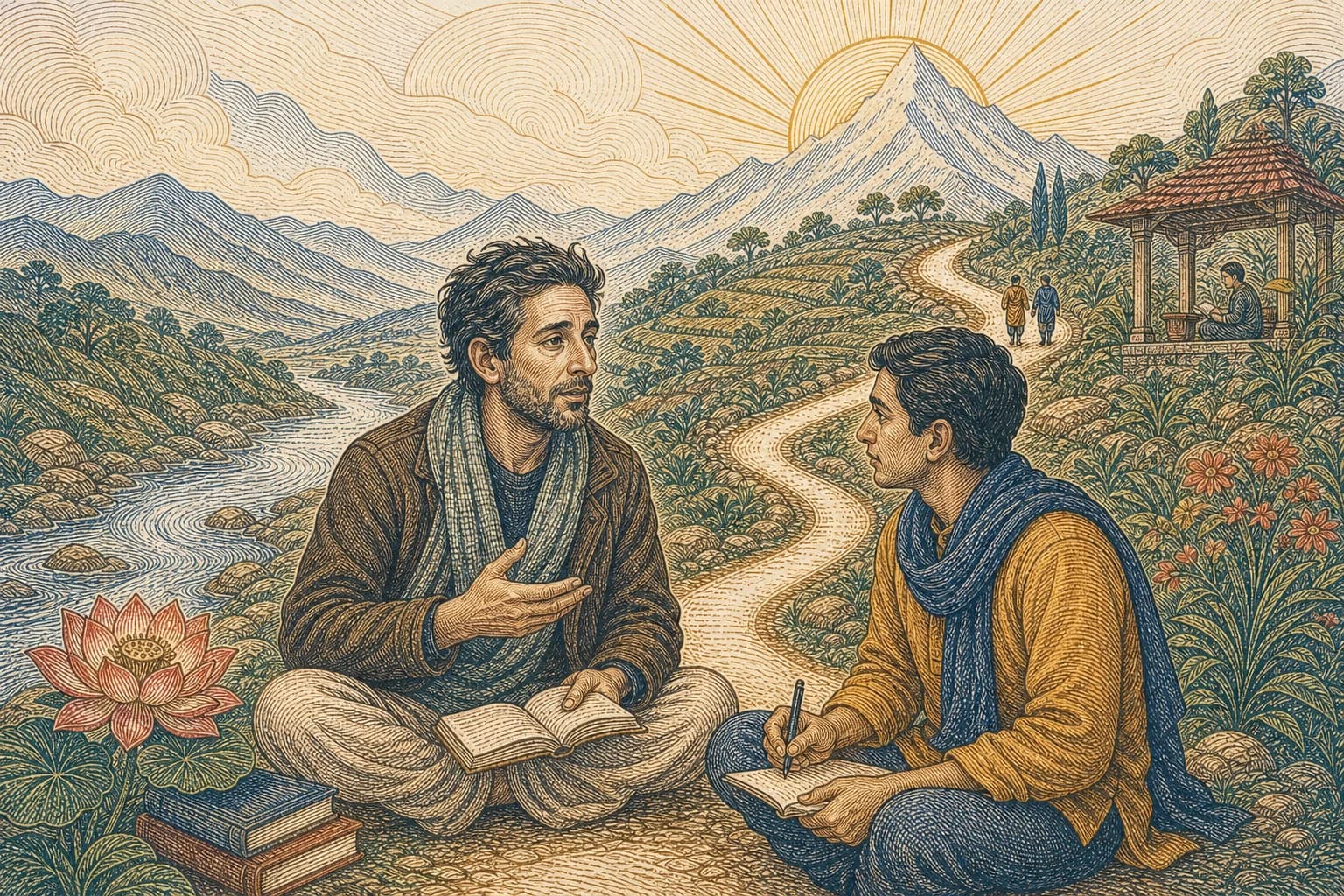
A study scene with learners, folios and a winding path
Encounter · recall · practise · discuss · teach · return
Contact notebook

Prepare a correction or question

Messages on this device

1 records

REVIEWED

Model correction · Exact claim and evidence

Page: [route]. Current claim: [exact wording]. Proposed change: [replacement]. Evidence: [source and location]. Why it matters: [accuracy, attribution, access or learning].

The learning rhythm

Every lesson moves from receiving to sharing

See the method
  1. 01Encounter
  2. 02Recall
  3. 03Apply
  4. 04Discuss
  5. 05Teach
  6. 06Return