
Skip to content
Community

The forum

Somewhere to ask, answer and disagree well. Signed-in members only, moderated, with every moderator action on the record.

Source boundary visible4 active units

Source-aware community practice

Ask, answer and disagree in a way that leaves sources and moderation actions inspectable.

The school developed these teaching notes. They are not presented as Aniruddha Dāsa's authored commentary. The source trail and limits remain visible for human review.

Learners moving from source reading to practice and teaching
Learn visibly: retrieve · make · discuss · teach · return
Learning outcomes
  • Create something that can be inspected
  • Keep source, interpretation and uncertainty visible
  • Use teach-back as evidence of understanding
Saved on this device0%
Course sequence

Make evidence at every step

Teach-back

Explain the result to another person without looking, then reopen the source and correct the explanation visibly.

Completion evidence

A local discussion with one question, one sourced reply and a transparent resolution.

Research and source trail
Read the complete teaching notesOpen
Full lesson readerFormative assessment included

Read less. Do more. Show what changed.

Every unit below contains an explanation, a worked model, immediate practice, a source boundary and a check for understanding. The familiar “learning pyramid” percentages are not used; its useful active modes are rebuilt here with retrieval, spacing, feedback and learner choice.

Encounter
Retrieve
Demonstrate
Discuss
Practise
Teach
Choose a lesson

All 4 lessons are complete.

Lesson 1 of 4

Claim

Write the smallest useful claim and intended reader.

1 · Understand the move

A useful discussion makes the question, source, confidence and disagreement inspectable. Standing comes from accountable participation.

In this lesson, the concrete target is A one-sentence brief. Begin by defining what a successful example would contain and what it would deliberately leave out. This makes the standard inspectable before anyone is assessed.

2 · Worked model

Restate the other person’s point fairly, answer the centre, attach the smallest sufficient source and name what remains uncertain.

I noticeI decideI verify
3 · Practise now

Put the source away and make a first attempt in ten minutes. Do not polish it. Reopen the source, underline corrections and write one sentence explaining why each correction mattered. Then use the result in a new situation.

Rewrite a strong disagreement so that a third reader can distinguish source claim, interpretation, experience and unresolved question.

4 · Check the boundary

Moderation should record the rule, evidence, action and appeal route. Removing a post must not erase accountability for the decision.

  • The result is visible: a one-sentence brief.
  • A reader can distinguish source, interpretation, illustration and uncertainty.
  • The learner can explain the central move without looking, then correct it from the source.

Autosaved privately on this device.
Performance assessment

Evidence before completion

Four-part rubric
Accuracy
Claims match the cited source and limits are named.
Understanding
The learner explains relationships, not only wording.
Application
The central move works in a new case or audience.
Teaching
Another person can follow, question and verify it.
Inspect sources and classroom resourcesOpen
Starter library3 complete model resources

Open, use and adapt - not an empty shelf

These complete, source-linked resources accompany Source-aware community practice. Each one includes a bounded reading, a visual sequence, an immediate practice and a direct source trail. They may be reviewed, rewritten or replaced without misattributing authorship.

Study tools, folios and learning symbols
Read · see · attempt · verify · teach
Model discussionResearch edition

What did you retrieve before reopening Bhagavad-gītā 2.13?

A prompt makes learning evidence shareable without turning memory gaps into status.

Complete reading

Post the relationship you reconstructed, the part you missed and the correction you made after reopening the source. Replies should ask one clarifying question or offer one exact reference, not compete over who remembered more.

A useful resolution summarises the source-backed agreement, identifies differing interpretations and leaves the remaining question open. The moderation log records any change of status.

Visual sequence
  1. 1Attempt
  2. 2Correct
  3. 3Reply with a source
Do it now

Write a reply that begins by restating the other learner’s point accurately before adding a source.

Source: Roediger & Karpicke · retrieval as learning
Model discussionResearch edition

When should a calendar result be checked locally?

Participants separate reproducible astronomy from practical observance guidance.

Complete reading

Share the date, time, timezone and coordinates used. Then state the astronomical result separately from the observance question. A reply is incomplete if it gives a fasting decision without naming the rule-set and local source.

Resolve the thread when the computation is reproduced and an authoritative local comparison is recorded, even if a convention difference remains. Do not hide the difference merely to produce one date.

Visual sequence
  1. 1Share inputs
  2. 2Name the rule
  3. 3Cross-check locally
Do it now

Turn an unsupported date claim into a reproducible question with all required inputs.

Source: IMD · Rashtriya Panchang
Moderation caseResearch edition

Disagree with the claim, preserve the person

A transparent moderation record distinguishes correction, warning and removal.

Complete reading

First identify whether the problem is factual error, missing provenance, disrespect or immediate harm. Request a correction when repair is plausible. A warning names the rule and expected change. Removal records the content, rule, evidence, action and appeal route.

Standing never exempts a member from source or conduct rules. A respectful minority interpretation may remain when it is identified and supported; repetition, intimidation or falsified citation are different issues.

Visual sequence
  1. 1Classify
  2. 2Choose proportionate action
  3. 3Record and allow appeal
Do it now

Write a moderation note that a person who disagrees with the action could still understand and audit.

Source: NCF 2023 · participative discussion and formative culture
Open practice and export toolsOpen
Complete local moduleAutosaves on this device

Learn by making something

Use the tool, inspect its limits, save evidence of your work, explain it to somebody else, then return and improve it. Model records are included so the workflow never begins as an empty form.

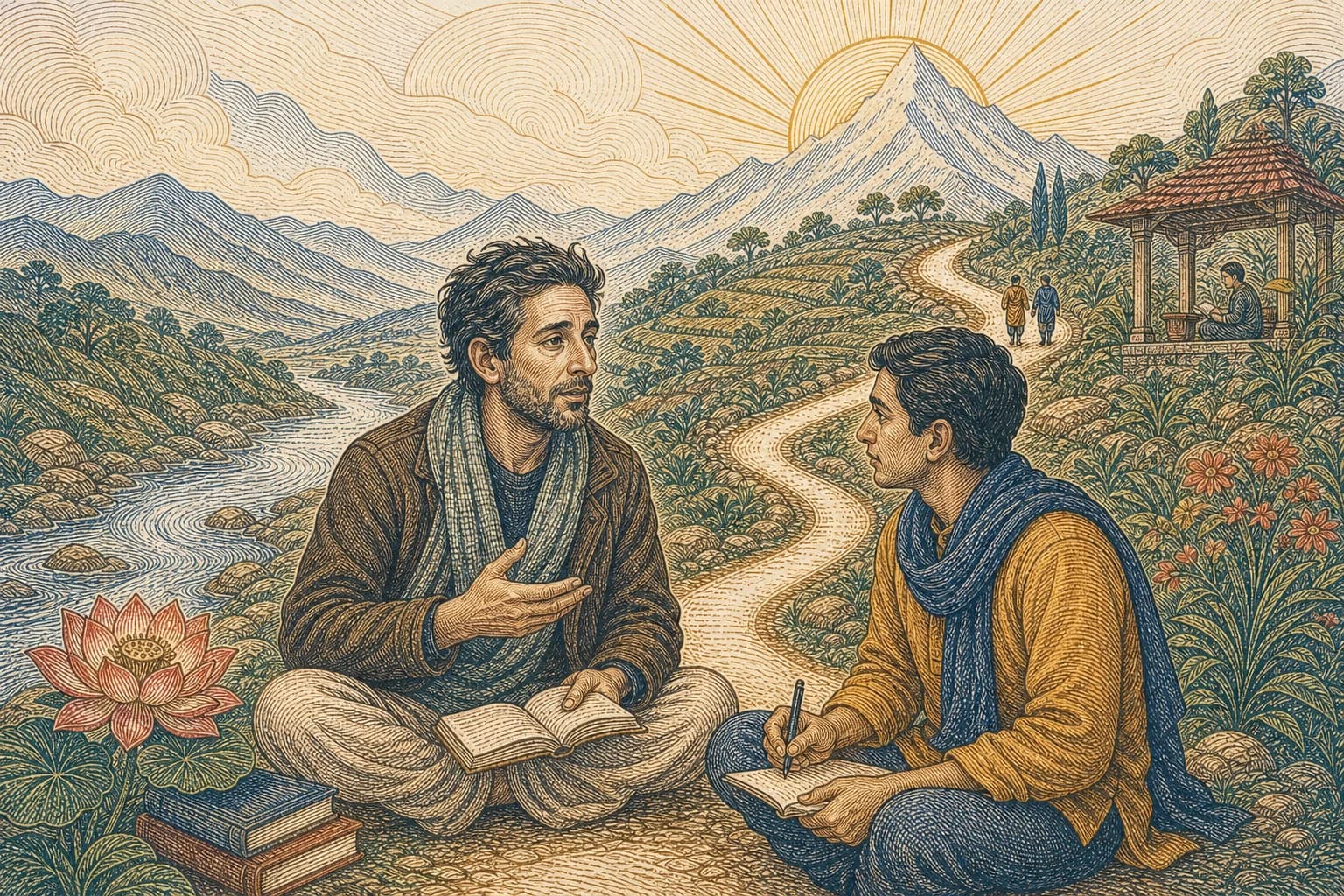
A study scene with learners, folios and a winding path
Encounter · recall · practise · discuss · teach · return
Start a discussion

Ask with enough context

This is the complete privacy-first local community workflow. Posts, replies and moderation states stay on this device and can be replaced by a reviewed network service later.

Moderation-ready board

Discussions

OPEN

What did you retrieve before reopening Bhagavad-gītā 2.13?

Share the relationship you reconstructed, the part you missed and the correction you made. Please distinguish direct observation from interpretation.

  1. Reply 1Model reply · I remembered the bodily stages but omitted the comparison to another embodiment. Reopening the verse changed my map from a list into two connected movements. Source checked at the verse page.
OPEN

When should a calendar result be checked locally?

Post date, time, timezone and coordinates first. Then separate the astronomical output from the practical observance question and name the rule-set required.

  1. Reply 1Model reply · A tithi interval can be computed for an instant, but fasting and pāraṇa guidance still requires the relevant local convention and an authoritative calendar comparison.
OPEN

How should we disagree with a sourced interpretation?

Restate the claim fairly, identify the exact point of disagreement, supply the smallest relevant source and name what remains unresolved.

The learning rhythm

Every lesson moves from receiving to sharing

See the method
  1. 01Encounter
  2. 02Recall
  3. 03Apply
  4. 04Discuss
  5. 05Teach
  6. 06Return