
Skip to content
Preacher's Classroom

Storytelling

Using scriptural narrative without exaggerating it, and keeping the difference visible between what scripture records and what you invented to make a point.

Source boundary visible4 active units

Storytelling with provenance visible

A vivid story can remain honest when its source, genre and invented connective details are clearly labelled.

The school developed these teaching notes. They are not presented as Aniruddha Dāsa's authored commentary. The source trail and limits remain visible for human review.

Learners moving from source reading to practice and teaching
Learn visibly: retrieve · make · discuss · teach · return
Learning outcomes
  • Classify a story before using it
  • Separate recorded event from illustrative reconstruction
  • Name the teaching point without forcing the story
Saved on this device0%
Course sequence

Make evidence at every step

Teach-back

Retell the story in 90 seconds, then state which details were source, tradition and illustration.

Completion evidence

A story card that another teacher can audit line by line.

Research and source trail
Read the complete teaching notesOpen
Full lesson readerFormative assessment included

Read less. Do more. Show what changed.

Every unit below contains an explanation, a worked model, immediate practice, a source boundary and a check for understanding. The familiar “learning pyramid” percentages are not used; its useful active modes are rebuilt here with retrieval, spacing, feedback and learner choice.

Encounter
Retrieve
Demonstrate
Discuss
Practise
Teach
Choose a lesson

All 4 lessons are complete.

Lesson 1 of 4

Find the smallest source

Locate the passage and record what it actually supplies.

1 · Understand the move

A teaching plan is only a hypothesis. The learner’s explanation, question and attempted application show whether the lesson worked.

In this lesson, the concrete target is A fact / silence table. Begin by defining what a successful example would contain and what it would deliberately leave out. This makes the standard inspectable before anyone is assessed.

2 · Worked model

Model the move once while naming your decisions. Mark the direct source, the cited interpretation and the present teacher’s illustration as three different layers.

I noticeI decideI verify
3 · Practise now

Put the source away and make a first attempt in ten minutes. Do not polish it. Reopen the source, underline corrections and write one sentence explaining why each correction mattered. Then use the result in a new situation.

Change the audience or time limit and rebuild the same lesson. If the central result disappears, the plan was organised around material rather than learning.

4 · Check the boundary

Do not fill silence with more explanation. Ask for an attempt, diagnose the exact gap, then give the smallest useful prompt.

  • The result is visible: a fact / silence table.
  • A reader can distinguish source, interpretation, illustration and uncertainty.
  • The learner can explain the central move without looking, then correct it from the source.

Autosaved privately on this device.
Performance assessment

Evidence before completion

Four-part rubric
Accuracy
Claims match the cited source and limits are named.
Understanding
The learner explains relationships, not only wording.
Application
The central move works in a new case or audience.
Teaching
Another person can follow, question and verify it.
Inspect sources and classroom resourcesOpen
Starter library3 complete model resources

Open, use and adapt - not an empty shelf

These complete, source-linked resources accompany Storytelling with provenance visible. Each one includes a bounded reading, a visual sequence, an immediate practice and a direct source trail. They may be reviewed, rewritten or replaced without misattributing authorship.

Study tools, folios and learning symbols
Read · see · attempt · verify · teach
Model lesson · 30 minutesResearch edition

One claim, one source, one learner action

A reusable lesson that protects source clarity while moving quickly from explanation to evidence.

Complete reading

Choose one bounded claim and one primary passage. Write what the passage supplies, what a named commentator supplies and what your own analogy supplies. If those cannot be distinguished on the plan, they will blur in speech.

Use six minutes to orient and model, eight for a supported attempt, six for pairs to compare, five for teach-back and five for correction and return. The teach-back is not an ornamental ending: it is the teacher’s clearest evidence about what to change.

Visual sequence
  1. 1Label the source layers
  2. 2Let learners attempt
  3. 3Teach back and revise
Do it now

Print a passage and mark S for source, I for identified interpretation and A for analogy. Rehearse the lesson once with a timer.

Source: Freeman et al. · active learning meta-analysis
Facilitator cardResearch edition

A question ladder that does not give the answer away

Four prompts move from noticing to explanation, transfer and evaluation.

Complete reading

Start with “What do you notice?” because observation gives every learner a legitimate entry point. Follow with “What relationship does the passage establish?” and wait long enough for an attempt before offering a cue.

Next ask for a new case: “Where would this distinction matter?” End with an evaluative question: “What evidence would change your conclusion?” This progression keeps questions attached to thinking rather than rewarding only quick recall.

Visual sequence
  1. 1Notice
  2. 2Explain
  3. 3Transfer
Do it now

Rewrite three lecture statements as questions. Beside each, write the evidence a useful answer would contain.

Source: IES · explanatory questioning and active retrieval
Printable rubricResearch edition

Teach-back: accurate, clear, bounded, useful

A four-line feedback sheet for peer rehearsal or post-class reflection.

Complete reading

Accuracy asks whether the source was represented fairly. Clarity asks whether a newcomer can follow the structure. Boundary asks whether interpretation and uncertainty were named. Usefulness asks whether the learner can now do something inspectable.

Score each dimension as “not yet”, “with a prompt” or “independently”. Add one exact observation and one next move. General praise does not tell the speaker what to repeat; general criticism does not tell them what to change.

Visual sequence
  1. 1Observe exactly
  2. 2Name one effect
  3. 3Choose one revision
Do it now

Record a two-minute explanation. Review it once without sound for visual structure and once with sound but without watching for vocal structure.

Source: NCF 2023 · varied, participative and formative learning
Open practice and export toolsOpen
Complete local moduleAutosaves on this device

Learn by making something

Use the tool, inspect its limits, save evidence of your work, explain it to somebody else, then return and improve it. Model records are included so the workflow never begins as an empty form.

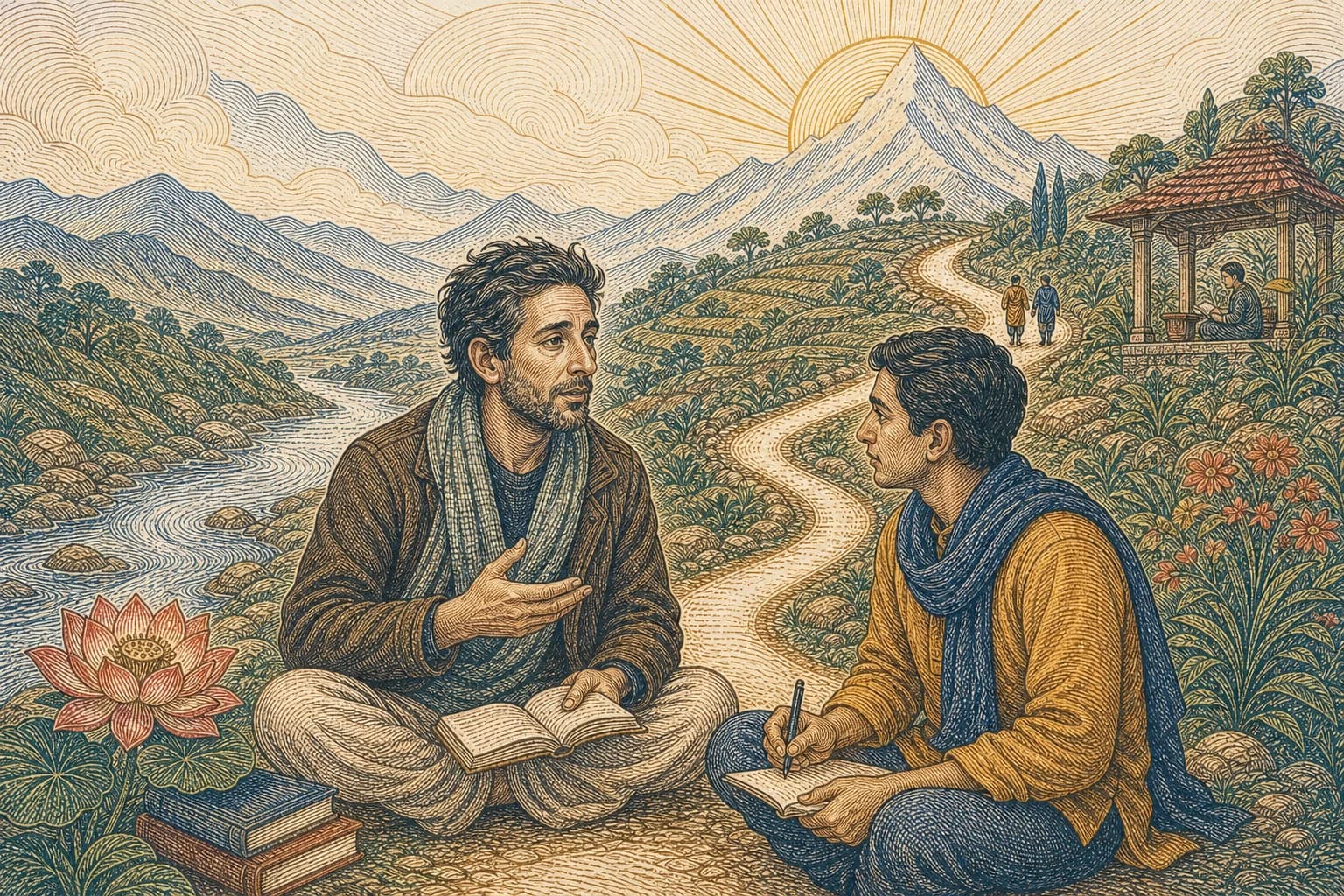
A study scene with learners, folios and a winding path
Encounter · recall · practise · discuss · teach · return
Lesson laboratory

Prepare for one observable result

Active-learning arc

Bhagavad-gītā 2.13

  1. Read the source aloud and mark exactly what it says.

  2. Close the text and reconstruct the central idea.

  3. Use one real case, worked example or demonstration.

  4. Ask for a question, objection or comparison.

  5. Let a learner explain it back in plain words.

  6. Choose the next review date or use in practice.

Saved privately on this device. Export before changing browsers.

The learning rhythm

Every lesson moves from receiving to sharing

See the method
  1. 01Encounter
  2. 02Recall
  3. 03Apply
  4. 04Discuss
  5. 05Teach
  6. 06Return