
Humility and the conditions of knowing
What happens when a virtue list is studied as a practice of inquiry rather than a scorecard?
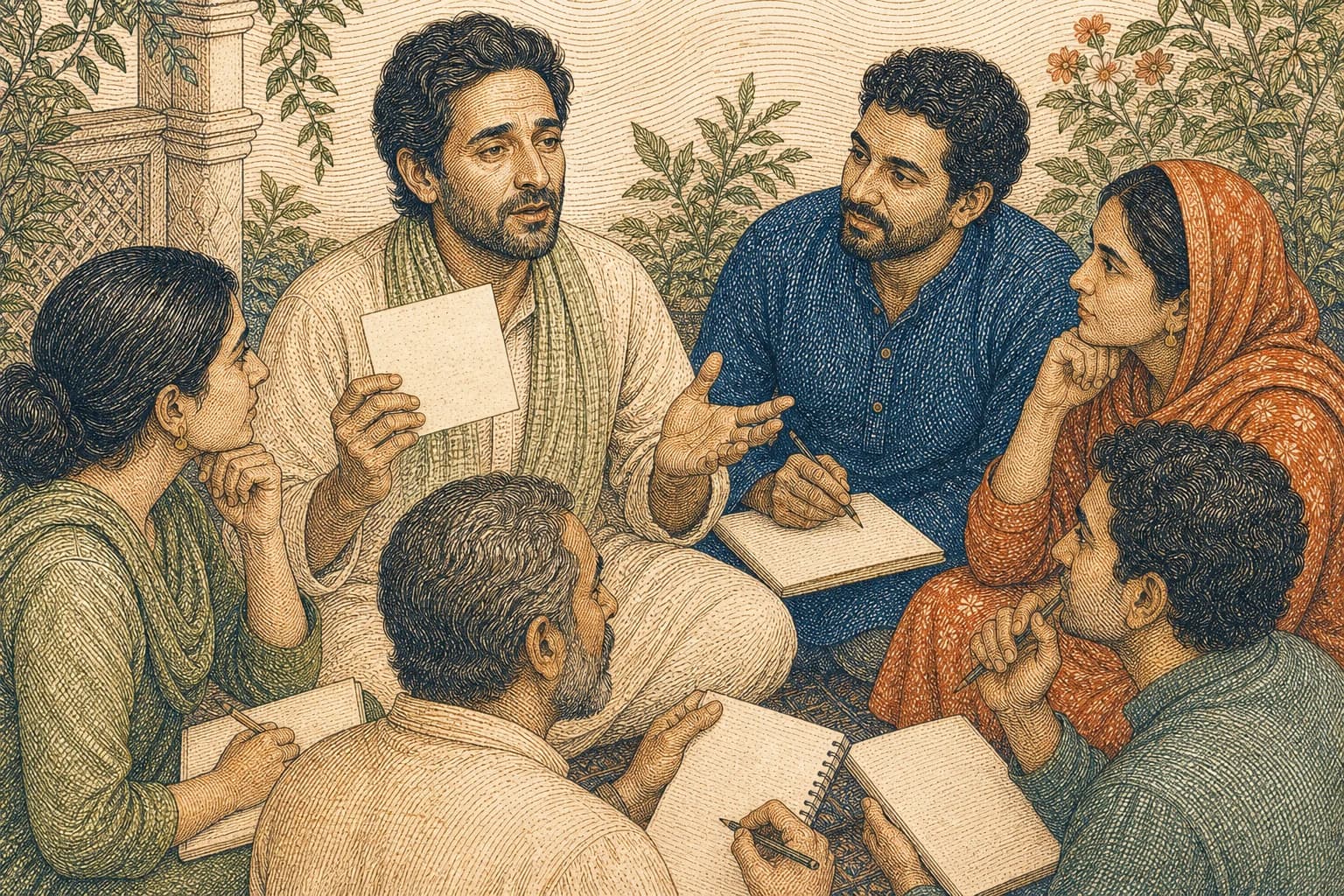
What learners should be able to do
Learners can locate humility within the passage’s list, distinguish description from self-advertisement, and formulate one observable inquiry practice.
A reflective inquiry class that examines one quality in a larger list, uses cases rather than self-ranking and produces a question a learner can genuinely test.
The lesson does not diagnose spiritual attainment. Definitions and theological claims beyond the visible list require an identified translation or commentary.
Source → learner action → evidence
Prepare only what the task uses
- BG 13.8–12 source range
- Two fictional dialogue cases
- Claim / evidence / revision cards
- Private inquiry sheet
Preserve the goal; vary the route
- ✓Do not require learners to disclose personal failures
- ✓Offer silent annotation before discussion
- ✓Use paired rehearsal before whole-group speaking
- ✓Accept an inquiry question in writing, audio or diagram form
Show the move before asking for it
A model makes the quality standard inspectable. Learners then solve a related - not identical - case.
Model intellectual humility as a visible research move: “I can support this clause; I cannot yet establish the larger claim; here is the source I would check.” Keep that move separate from declaring oneself humble.
Six modes, one connected question
Read the quality in its list
Display the wider source range so one term does not become an isolated slogan.
Mark list structure, repeated forms and translation decisions.
The quality remains connected to its passage context.
Rebuild the neighbourhood
Hide the list and ask for neighbouring qualities, allowing uncertainty.
Retrieve what is remembered, then use a different colour for correction.
The record distinguishes memory from reopened evidence.
Analyse two dialogue cases
Model the difference between modest tone and revisable reasoning.
Compare a polite but uncorrectable claim with a direct but evidence-responsive claim.
Pairs name the observable evidence for revision.
Ask whether virtue can be scored
Keep discussion on assessment design, not classmates’ character.
List what a teacher may observe and what remains inward or uncertain.
The class creates a no-score boundary.
Explain a practice of inquiry
Require one example and one explicit limitation.
Teach a partner how intellectual humility changes source study.
The partner identifies the limitation and evidence.
Choose one revisable question
Offer prompts about translation, context or application.
Write a question that can be revisited with a named source next week.
A testable inquiry replaces a self-rating.
Evidence before completion
- 1The term is studied inside its wider list.
- 2The learner distinguishes observable revision from a claim about inner virtue.
- 3The final inquiry names evidence that could change the answer.
Do not grade inward devotion, humility or character. Assess the stated task: source use, reasoning, revision and respectful participation.
Compare how two identified editions render amānitvam. Record the lexical decision and the practical consequence of each wording without declaring one self-evident.
Rehearse, teach, reflect, return
Mark a stage only when you deliberately prepared or taught it. The record supports reflection; it does not certify teaching quality.