
Qualities, patterns and observation
How can a class investigate the three guṇas without turning them into labels for people?
What learners should be able to do
Learners can describe the three-term model, apply it provisionally to a changing situation, and state why a person should not be reduced to one label.
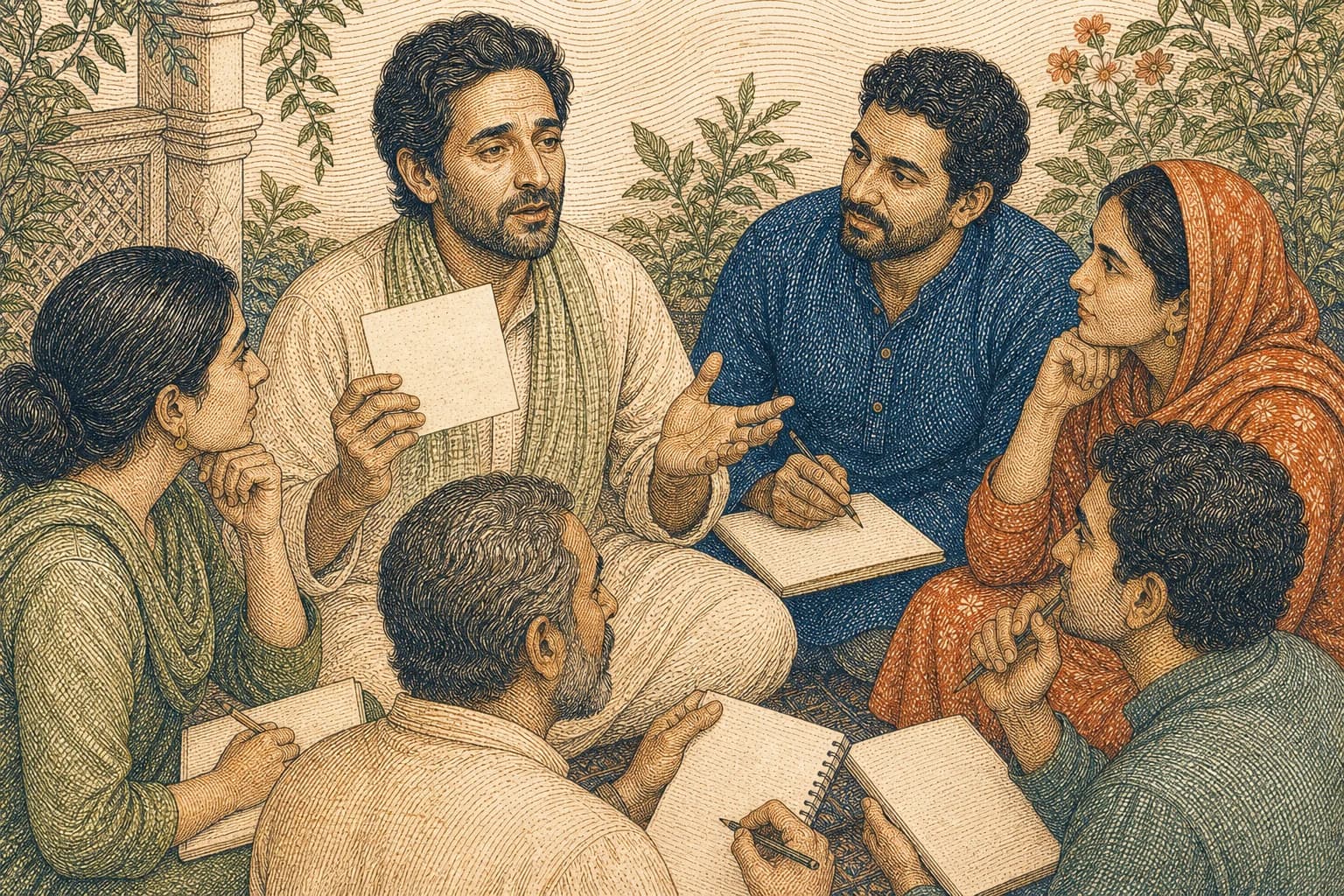
A case-comparison seminar that studies a conceptual model, tests it against situations and resists using the guṇas as fixed identities or social rankings.
The class uses BG 14.5 as an entry point and requires identified commentary for developed definitions. It does not turn a conceptual model into clinical diagnosis, caste claim or permanent identity.
Source → learner action → evidence
Prepare only what the task uses
- BG 14.5 and selected identified commentary excerpts
- Three fictional case sequences
- Pattern / person distinction cards
- Large comparison grid
Preserve the goal; vary the route
- ✓Distribute cases in advance for slower reading
- ✓Use fictional cases only; do not classify classmates
- ✓Allow groups to annotate, diagram or orally report
- ✓Define Sanskrit terms before inviting comparison
Show the move before asking for it
A model makes the quality standard inspectable. Learners then solve a related - not identical - case.
Model a changing case rather than a person label: one learner studies clearly in the morning, becomes agitated under deadline pressure and later avoids the task. Ask what the model may illuminate and what it cannot establish.
Six modes, one connected question
Build the source shelf
Read BG 14.5 and identify where later definitions would need additional passages or commentary.
Mark direct terms, relationships and unanswered definition questions.
A source-needed list prevents invented definitions.
Reconstruct the three-term model
Close all sources and request a relationship sketch.
Draw three terms around prakṛti and mark confidence, then reopen and correct.
Corrections are dated rather than erased.
Analyse a changing case
Demonstrate provisional language: “this pattern resembles,” not “this person is.”
Map one fictional case across time and attach evidence to every proposal.
The case map includes at least one change over time.
Challenge the model’s misuse
Assign groups one misuse: fixed identity, moral superiority or diagnosis.
Explain why the misuse exceeds the evidence and rewrite the claim.
Each group produces a boundary statement.
Teach the pattern-person distinction
Ask listeners to offer a counterexample that changes across context.
Give a two-minute explanation, respond to the counterexample and cite the source boundary.
Peer notes identify one strong link and one overreach.
Revisit with another passage
Assign one relevant later passage according to the teacher’s chosen edition.
Predict what the new source may clarify, then schedule the comparison.
The return task names a precise definition question.
Evidence before completion
- 1The three terms are related to the source rather than free association.
- 2Case claims remain provisional and evidence-linked.
- 3The learner can explain why pattern language must not become a permanent label.
Never invite learners to classify one another. Interrupt caste, race, disability, gender or mental-health stereotyping immediately and return to the source and the fictional case.
Trace one term through a later chapter passage using the concordance. Record continuity, development and translation differences without assuming identical usage.
Rehearse, teach, reflect, return
Mark a stage only when you deliberately prepared or taught it. The record supports reflection; it does not certify teaching quality.